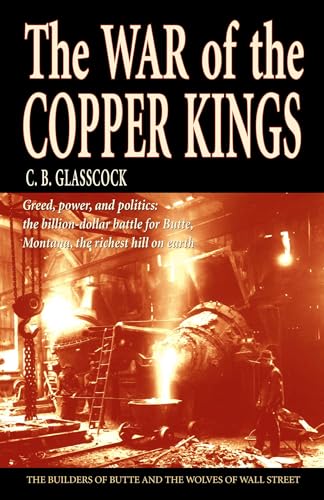
Copper was the metal behind the electrical age, and Montana became one of the places where ore, money, and political power fused into something larger than any of its parts.
The story of the Copper Kings is not simply a story of mining. It is a story of what happens when a single commodity becomes strategically essential at the same moment that a handful of operators control most of its supply. The electrification of America in the late nineteenth century created demand for copper wire at a scale the world had never seen. The men who controlled the Montana copper district — Marcus Daly, William Clark, Augustus Heinze, and eventually the Anaconda Copper Mining Company — found themselves holding a chokepoint in the infrastructure of modernity.
That chokepoint turned mines into fortunes. It also turned Montana into a battleground.
The World Before the Fortune
In 1880, copper was a useful industrial metal but not yet a strategic one. The transcontinental telegraph had created some demand. Electrical generators were experimental. Thomas Edison’s Pearl Street Station, the first commercial power plant in America, did not open until 1882.
Within a decade, everything changed. Edison’s direct current and then Nikola Tesla’s alternating current system transformed electricity from a curiosity into a distributed infrastructure. Every mile of transmission line, every electric motor, every lighting circuit required copper wire. Cities began electrifying street railways. Factories converted from steam to electric drives. The demand curve for copper turned nearly vertical.
The timing of the electrification boom coincided with the discovery of enormous copper deposits in Butte, Montana. The same mountain that had been mined for silver turned out to contain some of the richest copper ore on earth. Geography and timing aligned in a way that produced a decade of extraordinary wealth and a generation of political conflict.
The Rise
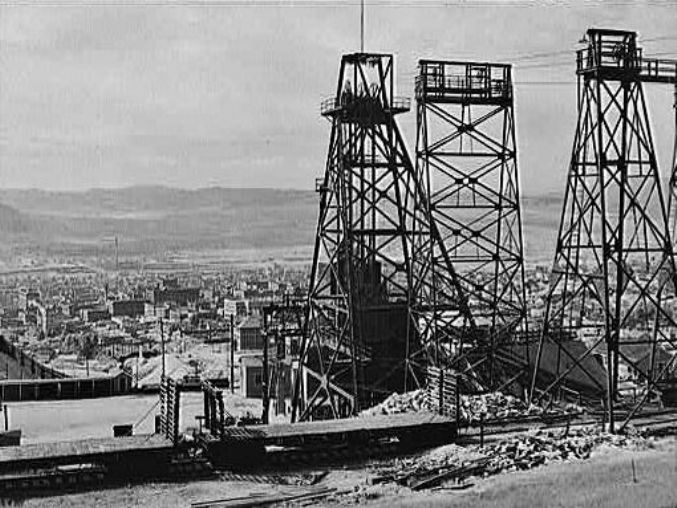
Marcus Daly, an Irish immigrant who had learned mining in Nevada’s silver districts, recognized the copper potential of Butte before most. In 1881, he acquired the Anaconda silver mine with backing from George Hearst, James Ben Ali Haggin, and Lloyd Tevis — California investors who had already profited from Nevada silver. When Daly’s crews struck a massive copper vein, the partnership pivoted entirely.
The Anaconda Copper Mining Company, incorporated in 1891, was not just a mining company. Daly built a complete vertical system: copper mines, a concentrating mill, a smelter at the new company town of Anaconda, a railroad to move ore, timber operations to supply mine timbers, and a water system. Like the steel trust J.P. Morgan assembled two decades later, the Anaconda structure was designed to control every step in the supply chain — from ore in the ground to refined copper at the market.
Control of the supply chain was not just an operational decision. It was a defensive one. A copper producer who depended on independent smelters, railroads, or timber suppliers was vulnerable to anyone who could control those inputs. Daly’s system eliminated that vulnerability — and in doing so, erected barriers that made it progressively harder for new entrants to compete.
The Expansion of Power
The War of the Copper Kings — the multi-decade political and financial conflict between Daly, William Clark, and Augustus Heinze — was in one sense a personal rivalry. In another, it was a collision between three different strategies for controlling the same geographic bottleneck.
Clark, a self-made merchant turned miner, sought political power to protect his mining interests. He was elected to the U.S. Senate in 1899 after a vote-buying scandal that became notorious even by the standards of the Gilded Age. Heinze used the courts — filing claim-jumping suits based on the “apex” rule of mining law, which allowed underground veins to be followed wherever they led. For years, Heinze used litigation to drain his rivals’ resources.
The resolution came through Standard Oil. The Amalgamated Copper Company, formed in 1899 with Standard Oil money managed by Henry Rogers and William Rockefeller, acquired Anaconda and began buying out the other major producers. Standard Oil’s strategy of consolidating competitive industries through financial control was applied directly to copper. Amalgamated became one of the largest companies in America — and one of the most controversial, accused of manipulating copper prices and stock market speculation.
The Hidden Strategy Behind the Fortune
The hidden strategy behind the Copper Kings was not simply controlling mines. It was controlling the interface between natural resource extraction and the infrastructure buildout of a new technological era.
Copper demand during electrification was inelastic in a way that made the position extraordinary. Utilities could not substitute another metal for copper wire without rebuilding their entire infrastructure. Manufacturers could not electrify their factories without the wiring. Cities could not run their streetcar systems without the conductor metal. Every actor who wanted access to the electrical future had to pass through the copper bottleneck.
Compare this to the nitrate empire in South America, which controlled the soil nutrients that agricultural civilization required, or to Standard Oil’s control of petroleum refining. Each of these monopolies occupied the same structural position: ownership of the scarce input that made the broader economy possible. The specific resource changes. The logic — control the chokepoint before anyone else understands what the chokepoint is — remains constant.
The Cost, Risk, or Collapse
The Anaconda story has three phases of collapse.
The first was the Panic of 1907 and its aftermath. Amalgamated Copper, heavily leveraged and deeply entangled with trust company finance, became part of the liquidity crisis that triggered the panic. The stock manipulation that Amalgamated’s management had practiced during the boom years made it a symbol of the trust company excess that progressives targeted for regulation.
The second was the long decline of Butte. As the richest surface ores were exhausted, the mining became more expensive, more capital-intensive, and less profitable per ton. The “richest hill on earth” became a story about the costs of extraction — to workers, to the environment, and to the community that had organized its entire economy around copper production.
The third was nationalization. When Anaconda expanded into Chile’s copper deposits in the twentieth century, it encountered a different kind of political risk — a government that eventually nationalized the mines. The political vulnerability of strategic resources in foreign jurisdictions recurred across the entire commodity empire era.
Lessons for Modern Business Readers
Find the chokepoint before the market understands it. Daly recognized copper’s potential before electrification made it obvious. The value of early control came precisely from its invisibility — once the bottleneck was apparent, competition arrived and prices tightened.
Vertical integration is both an operating strategy and a defensive one. Anaconda’s smelters, railroads, and timber operations were not simply cost-reduction measures. They removed vulnerabilities that rivals could exploit and made the system harder to disrupt.
Financial control requires financial discipline. Amalgamated Copper’s stock manipulation and leverage created short-term gains and long-term fragility. The strategy that worked during the bubble became a liability during the panic.
Political power is an industrial input, not a side effect. The Copper Kings’ investment in Montana politics — Clark’s Senate seat, Daly’s newspaper, Heinze’s legal battles — was not incidental to their business strategy. It was part of the infrastructure of control.
Strategic resources become political resources. When copper became essential to the military and industrial economy, Anaconda’s position became a matter of national interest — which eventually meant it was subject to national intervention.
How This Fits the Hidden Fortunes System
The Copper Kings adds a strategic metals pillar that connects electrification history to the broader Hidden Fortunes map of industrial monopolies. It links steel, oil, nitrates, and aluminum into a pattern: the largest Gilded Age fortunes were built by controlling the scarce industrial inputs that every other sector of the economy depended on.
Conclusion
The Copper Kings show what happens when a single commodity becomes the enabling material for a new technological era. Montana’s mines did not merely produce copper. They produced the wiring that made electrical civilization possible — and the men who controlled those mines extracted a decade’s worth of extraordinary leverage from that position.
The lesson endures. Every new technological system has its enabling bottleneck. The resources and technologies change. The strategy of finding the chokepoint before the market does — and building the infrastructure to control it — remains one of the most durable formulas for durable wealth.
Further Reading
For readers who want to explore the intersection of natural resource extraction, financial power, and industrial politics that defined the Copper Kings era, the story of Anaconda connects directly to the broader history of American industrial consolidation. Copper Camp and the broader literature on the Butte mining wars offer the ground-level view; for the financial architecture, the story begins and ends with Standard Oil’s expansion into metals.