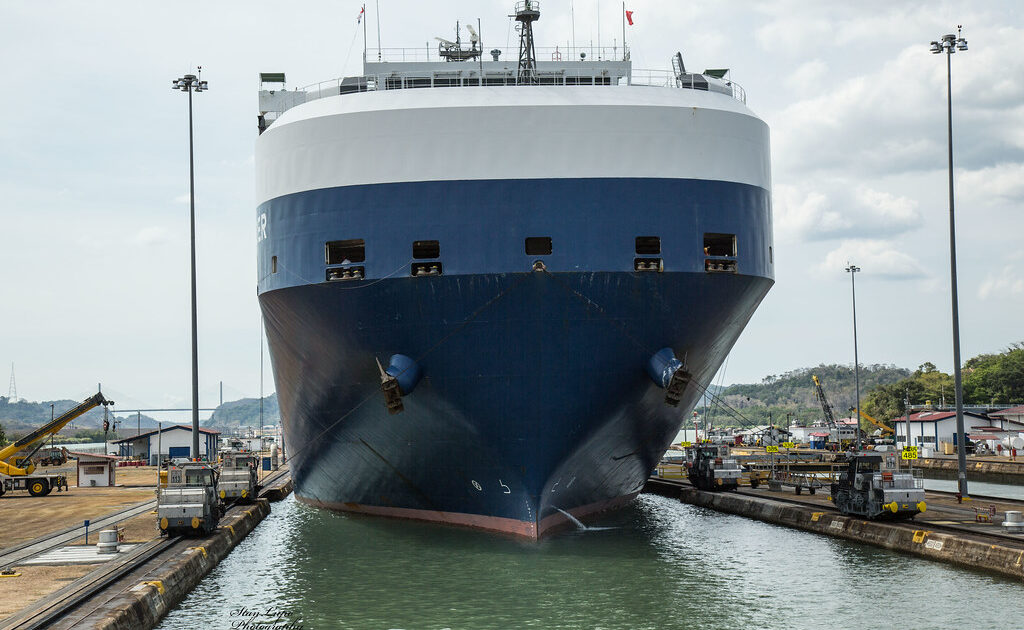
Some fortunes come from what the world consumes. Others come from how the world moves.
The Panama Canal belongs to the second category. It was not just a feat of engineering or a triumph of persistence over geography and disease. It was a private and political answer to one of the oldest questions in empire: how do you make geography pay you every time someone else needs to cross it?
That question had motivated chartered trading companies for centuries. The British East India Company and the Dutch East India Company had built their fortunes by controlling access to trade routes — positioning themselves at the layer that every merchant had to pass through before reaching the market. The Panama Canal represented the same logic applied to geography itself: compress the map, own the compression, and extract value from every actor dependent on the resulting shortcut.
Understanding how that logic was designed, contested, and ultimately institutionalized reveals something fundamental about how infrastructure fortunes are built — and why they endure long after the original builders are gone.
The World Before the Fortune

Before the canal opened in 1914, the world’s shipping systems were longer, slower, and more expensive than geography required. Freight and fleets moving between the Atlantic and Pacific faced a choice between two bad options: the long voyage around South America’s Cape Horn — notoriously dangerous, adding roughly 8,000 miles to the journey between the American coasts — or the patchwork of overland transit routes across the Isthmus of Panama that were operationally narrow, slow, and fragile.
In trade history, distance is never just distance. It is fuel, spoilage, insurance premiums, working capital tied up in transit, naval response time, and competitive position. The longer a route remains, the more friction it imposes on everyone using it. That friction could keep some trades thin, make some empires slower to respond to crises, and protect certain incumbents simply because the route itself was prohibitively hard.
The California Gold Rush of 1848 dramatized this vulnerability for American commerce. The fastest route from the East Coast to California ran through Panama — not by canal, but by foot, mule, and river across a malaria-ridden jungle. Gold seekers who survived the crossing still faced weeks of waiting for Pacific-side passage. The economic cost of this bottleneck was visible, measurable, and politically intolerable to an expanding continental power.
This is why canal projects attracted attention long before they attracted successful execution. The French attempt under Ferdinand de Lesseps in the 1880s — backed by massive public investment from French retail investors — collapsed under the weight of disease, engineering miscalculation, and financial fraud. The question was not whether the shortcut was worth building. The question was whether any combination of finance, technology, and political will could actually build it.
The Rise

The American attempt succeeded where the French failed, but not primarily because of superior engineering. The decisive advantages were political will, institutional learning from the French failure, and a medical breakthrough that transformed the underlying conditions of the project. Walter Reed’s work on yellow fever and William Gorgas’s systematic mosquito eradication program reduced mortality from tropical disease to manageable levels — making sustained construction possible for the first time.
The political structure was equally deliberate. The United States did not simply contract to build a canal in an existing country. It negotiated Panama’s separation from Colombia in 1903, then secured a treaty granting the United States effective sovereignty over the Canal Zone in perpetuity. The canal was built inside a corridor of American political control, which meant that the infrastructure and the strategic advantage it provided could not be expropriated by the host government.
This structure — infrastructure embedded in a politically controlled corridor — was not accidental. It reflected a clear understanding that building the canal and controlling the canal were two distinct problems requiring two distinct solutions. Engineering could address the first. Only political power could guarantee the second.
By the time the canal opened in August 1914 — the same month the First World War began in Europe — it was already an asset of extraordinary strategic value. Ships that had previously spent weeks rounding Cape Horn could now transit the isthmus in under ten hours. The savings in time, fuel, and exposure to risk were not marginal — they were transformational for every maritime trade route that connected the world’s two great oceans.
The Expansion of Power

The canal’s power came from its ability to convert geography into repeated leverage. Every ship that transited it was purchasing access to compressed distance. Every fleet that planned its operations around it acknowledged that the canal had become structurally indispensable. Every business model premised on faster Atlantic-Pacific flows was implicitly paying tribute to the canal’s existence.
This is how chokepoints become fortunes. They sit upstream of countless transactions, extracting value not from any single trade but from the aggregate flow that depends on them. Like Hudson’s Bay Company’s monopoly over the fur trade routes of North America, the canal did not need to own every cargo on earth. It only needed to matter to the routes that moved that cargo. Once it mattered enough, the economics multiplied outward.
The strategic dimension expanded as the canal proved its military importance. During both World Wars, the canal allowed the United States to move naval assets between oceans without maintaining two separate fleets of equivalent size. This strategic advantage was not priced into transit fees — it was a positive externality that flowed entirely to American military planners. The canal’s commercial returns understated its total value to its controlling power by an enormous margin.
The geopolitical implications compounded over decades. Countries whose trade depended on Atlantic-Pacific flows had to structure their commercial relationships with an awareness that one chokepoint — controlled by a single power — sat across every calculation. The canal created what strategists call a point of leverage: a location where disproportionate influence could be applied at relatively low cost to the controller and high cost to anyone who depended on free passage.
The Hidden Strategy

The hidden strategy behind the fortune was geography monetized through compulsion. The canal worked because it offered savings that no rational shipper could ignore at scale. Once enough traffic had a strong reason to pass through one controlled corridor, geography itself became a product — one that could be priced, administered, defended, and politically leveraged.
This is what distinguishes chokepoint fortunes from ordinary infrastructure investments. A railroad or a port can be bypassed, replicated, or competed with. A canal connecting two oceans at the only viable crossing point on a continent cannot. The engineering that created it also created a natural monopoly of the most durable kind: one backed by physical geography and defended by state power.
The pricing logic that followed was sophisticated. Canal fees were set not at cost-recovery levels but at the maximum the traffic would bear given the alternatives — primarily the Cape Horn route. This meant the canal captured a large fraction of the time and fuel savings it generated for users, leaving them better off than the alternative but transferring a substantial share of the gain to the canal’s controller. The toll was not arbitrary; it was calibrated to the economic value of the shortcut.
The comparison between chartered trading companies and the canal reveals a recurring pattern in how geography generates durable advantage. In each case, the winning formula combined physical control of a critical node, political protection that prevented competitive entry, and pricing power calibrated to extract maximum value from dependent flows. The names and centuries differed; the underlying mechanism remained consistent.
The Cost and the Risk

But chokepoint fortunes are never morally uncomplicated. The canal was built on the labor of tens of thousands of workers — primarily West Indian and Southern European immigrants — under conditions that produced massive casualties even after the sanitary improvements that had addressed yellow fever. The racial hierarchy of the Canal Zone, which paid workers differently based on nationality and skin color through the notorious ‘gold roll’ and ‘silver roll’ classification, embedded inequality into the canal’s operational structure from the beginning.
The political costs to Panama were profound and lasting. The original Hay-Bunau-Varilla Treaty of 1903 granted the United States rights that amounted to sovereignty over a strip of Panamanian territory, including the right to intervene in Panamanian affairs to maintain order. The canal had been built, in effect, by trading Panamanian sovereignty for American capital and military protection. That bargain shaped Panamanian politics for three generations.
The strategic fragility inherent in every chokepoint also became apparent over time. The more central the canal became to global commerce, the more exposed it became to political contest, military threat, and demands for renegotiation. The 1977 Carter-Torrijos Treaties, which committed the United States to return the canal to Panama by 1999, represented the resolution of this tension — but only after decades of Panamanian political pressure that occasionally threatened the canal’s operational continuity.
The canal’s handover to Panama in 1999 also revealed something important about the durability of chokepoint fortunes when ownership changes. The Panama Canal Authority took over operations and promptly expanded them, completing a $5.25 billion expansion of the locks in 2016 that allowed the canal to accommodate the next generation of ultra-large container ships. The chokepoint endured; only the beneficiary of the toll changed.
Lessons for Modern Business Readers

The Panama Canal story offers six lessons that apply far beyond the specific history of one waterway.
First, control the route, not only the product. Businesses obsess over what they sell, but many of the most durable fortunes in history come from controlling the path that everyone else must use. The canal’s controller did not need to own any of the cargo moving through it — only the corridor through which cargo had to pass.
Second, compression creates pricing power. When you reduce time, friction, and uncertainty for a large network of users, you create an asset with extraordinary leverage over that network’s economics. The canal captured a fraction of the savings it generated, but those savings were large enough that even a fraction represented enormous value at scale.
Third, infrastructure becomes strategic faster than builders expect. Once an asset matters to enough trade and enough state power, it stops being neutral and starts being contested. The Panama Canal was a commercial project that became a geopolitical instrument within a decade of opening. Any infrastructure investment that crosses a certain threshold of essential use should be analyzed through this lens.
Fourth, great systems sit upstream of many transactions. The strongest business position often lives above many individual deals rather than inside any one of them. Platform businesses, payment networks, and logistics chokepoints share this architecture: they are most valuable precisely because their value is distributed across countless dependent transactions rather than concentrated in any single one.
Fifth, geography can be redesigned into a business model. Natural limits are not always permanent limits. The operator who reconfigures the map — whether by building a canal, laying a submarine cable, or acquiring a strategic port — can reconfigure the market that depends on it. The constraint that frustrates everyone else becomes the asset that powers one player’s advantage.
Sixth, scale magnifies both profit and scrutiny. The more essential the infrastructure, the more ethical, political, and competitive pressure it attracts. The canal’s history of labor exploitation, unequal treaties, and eventual renegotiation demonstrates that chokepoint advantages, while durable, are not unconditional — they depend on maintaining enough legitimacy with the users and governments who could, at sufficient cost, find alternatives or force renegotiation.