The fortune in this story did not begin with the object most people notice first.
It began with a constraint. In one era, that constraint was credit. In another, it was rail access, industrial capacity, political permission, or energy supply. The visible story around Alcoa and its strategic control of aluminum production is important, but the deeper question is sharper: who controlled the layer everyone else needed before they could grow?
That is the Aluminum Trust. Not just a company with market share, but a system that made itself indispensable before rivals understood what they were competing against.
The World Before the Fortune
In the 1880s, aluminum was a curiosity. It was lighter than steel, resistant to corrosion, and almost impossible to produce at scale. Napoleon III served banquets with aluminum cutlery because it was more expensive than silver. The metal was real. The industrial method was not.
That changed in 1886. Charles Martin Hall, a young chemist in Oberlin, Ohio, discovered a practical electrolytic process for smelting aluminum from bauxite ore. He filed for a patent. So did Paul Héroult in France, independently, on the same year. Hall’s American patent became the foundation for what would eventually become the Aluminum Company of America — Alcoa.
The system that formed around Hall’s process was not simply a company. It was a control architecture. Bauxite deposits had to be secured. Smelting required massive, sustained electricity — more than most factories of the era could generate. Every link in the chain had to be owned, financed, or locked up before a competitor could credibly enter the market.
The Rise
Between 1888 and 1909, Alcoa held a complete monopoly over U.S. aluminum production. The mechanism was straightforward: Hall’s original patents, combined with systematic acquisition of bauxite rights and power contracts near Niagara Falls, made independent entry economically impossible.
This pattern will be familiar to any reader who has followed Standard Oil’s pipeline strategy or the early network controls of the Bell System. The specific asset changes. The logic does not. Own the chokepoint. Make it expensive to build around. Grow the dependency before the public has language for what is happening.
Alcoa added vertical integration. It mined its own bauxite, generated its own electricity, operated its own smelters, and sold finished aluminum to manufacturers who had no alternative domestic supplier. When the original Hall patents expired in 1909, Alcoa had a portfolio of secondary patents, proprietary processes, and locked supply relationships that extended its effective control for two more decades.
The Expansion of Power
The expansion phase is where the Alcoa story becomes larger than one company or one set of patents.
Aluminum demand grew with electrification, aviation, construction, and eventually military production. Each new use case reinforced Alcoa’s position because Alcoa controlled the only reliable domestic supply chain. A manufacturer who needed aluminum had to negotiate with Alcoa on Alcoa’s terms. The bottleneck was not a patent anymore. It was the accumulated infrastructure of mines, smelters, power plants, and long-term supply contracts.
The Mellon banking family of Pittsburgh became major investors in Alcoa during this period. Andrew Mellon, later U.S. Secretary of the Treasury, helped finance the company’s expansion — a connection that created political complexity when antitrust scrutiny eventually arrived. As J.P. Morgan demonstrated with U.S. Steel, the largest industrial monopolies of the Gilded Age were rarely the creation of one operator. They required patient financial backing from institutions willing to bet on bottleneck control.
By the 1930s, Alcoa controlled approximately 90 percent of U.S. aluminum production. Its international affiliate, Aluminium Limited (now Alcan), managed similar concentration in Canada and Europe. The structure looked less like a company and more like a coordinated industrial system with sovereign characteristics.
The Hidden Strategy Behind the Fortune
The hidden strategy behind Alcoa’s dominance was controlling the energy-heavy production chain behind a metal that became essential to modern transport, construction, and defense.
That strategy worked because it moved the competitive fight away from the obvious battlefield. Rivals competed on products. Alcoa competed on infrastructure. A competitor who wanted to enter the U.S. aluminum market in 1920 did not need to make better metal. They needed bauxite mines, transmission lines, smelting capacity, and financing — all at once, against a company that had spent thirty years building exactly those assets.
The most durable wealth is rarely built by exposure alone. Exposure can produce gains in a favorable cycle. Control can survive the cycle. The difference is whether an actor depends on favorable conditions or whether conditions begin to depend on the actor.
The Cost, Risk, or Collapse
The backlash arrived in stages.
The U.S. Department of Justice filed an antitrust case against Alcoa in 1937. The litigation ran for years. In 1945, Judge Learned Hand issued the landmark opinion in United States v. Alcoa, ruling that Alcoa’s market share itself constituted an illegal monopoly under the Sherman Act — not because of predatory conduct, but because of the effect of sustained dominance. The ruling was a significant shift in antitrust jurisprudence. The government did not need to prove bad behavior. Size and structural control were enough.
The remedy was gradual. During World War II, the government had built new aluminum plants to meet war demand. After the war, those plants were sold to Reynolds Metals and Kaiser Aluminum, creating the first credible domestic competitors. Alcoa’s market share declined — not because a rival had beaten it, but because a government intervention had subsidized the alternative.
The political vulnerability of energy-intensive monopolies is always the same: the public eventually sees the bill. In Alcoa’s case, the bill was war production contracts, energy subsidies, and the cost of a market where one company set the terms for an entire industrial input.
Lessons for Modern Business Readers
Control the layer beneath the obvious market. The most valuable position governs access, timing, or infrastructure before the visible transaction happens. Alcoa’s patents expired. Its power contracts and bauxite rights did not.
Dependency compounds faster than attention. Attention creates surges. Dependency creates recurring leverage. The stronger the dependency, the less the owner has to win every surface-level contest.
Finance decides what scale can survive. Alcoa’s expansion required patient capital — the Mellon connection was not incidental. Industrial monopolies are always also financing stories.
Bottlenecks become political once the public sees the bill. Private advantages can look brilliant until communities, suppliers, or governments understand who is absorbing the cost of the constraint.
Antitrust arrives after the system is built. The Alcoa ruling came sixty years after Hall’s patent. By then, the industrial architecture had already shaped an entire century of American manufacturing.
How This Fits the Hidden Fortunes System
The Aluminum Trust adds a mechanism that Hidden Fortunes has not covered elsewhere: control of energy-intensive metal production during a period of rapid industrial expansion.
It connects naturally to the site’s existing articles on U.S. Steel, Standard Oil, and the Bell System. Each of those stories is a variation on the same structural question: who controls the scarce layer that other ambitious actors must pass through? Alcoa’s answer was energy, bauxite, and smelting capacity. The question itself is timeless.
Conclusion
The Aluminum Trust shows how a material empire forms when technology, energy, patents, and demand converge at the same point. Alcoa’s story is not simply about metal. It is about controlling the industrial layer that made modern lightness possible — and holding that layer long enough to define the terms of a century.
The lesson for today is not theatrical. It is structural. Capital keeps looking for chokepoints. Operators keep looking for dependency. Regulators keep arriving after private systems have already reorganized the market.
Further Reading
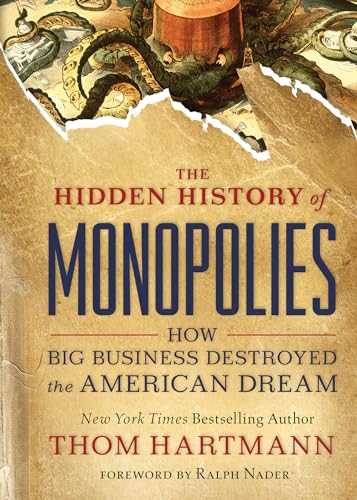
For readers who want to go deeper on monopoly structures and the hidden logic of industrial control, The Hidden History of Monopolies by David Dayen is a sharp and readable next step. It examines how market concentration shapes everyday economic life — and why the mechanisms Alcoa used continue to reappear in modern industries.