Some fortunes are built by owning the road. Others are built by moving the road of the economy itself.
When the Erie Canal opened in October 1825, it did not simply provide a cheaper route between the Hudson River and Lake Erie. It fundamentally altered the commercial geography of North America. Goods that had previously moved over the Appalachian Mountains at enormous cost could now travel by water — at a fraction of the freight cost — between the interior of the continent and the Atlantic. The Panama Canal would later perform a similar function for transoceanic shipping. The Erie Canal performed that function for a nation still deciding which cities and corridors would anchor its commercial future.
The canal was not primarily a private business. It was a state-financed public infrastructure project funded by New York State bonds — and its success created a cascade of financial consequences that extended far beyond the tolls the state collected. The Rothschilds’ Suez loan showed how infrastructure finance could produce lasting political and financial influence. The Erie Canal showed how public infrastructure investment could concentrate commercial advantage in the state that made the bet — not just for a generation, but for a century.
Vanderbilt’s later railroad empire competed directly with the canal and eventually reduced its commercial significance. But by then, the canal had already done its most important work: redirected the center of gravity of American commerce toward New York City in ways that compounded over decades and proved nearly impossible for rival cities to undo.
The World Before the Fortune

Early America was still deciding which cities and corridors would dominate internal trade. Transport bottlenecks mattered because they determined where surplus, merchants, financing, and future bargaining power would accumulate.
In 1817, when construction of the Erie Canal began, the American interior was economically isolated in ways that are difficult to imagine today. Shipping a ton of goods from Buffalo to New York City by road cost around $100. The same goods could be shipped from Liverpool to New York for $9. The Appalachian Mountains were not merely a geographic barrier — they were an economic barrier that disconnected the interior from Atlantic trade networks and from the capital those networks generated.
Baltimore, Philadelphia, Boston, and New York were all competing for the commercial hinterland of the interior. Each had geographic advantages. Baltimore had access to the Chesapeake and Ohio corridor. Philadelphia had the Lancaster Turnpike and access to the Susquehanna Valley. Boston had sea access to northern New England. New York had the Hudson River — and, after 1825, the Erie Canal.
Governor DeWitt Clinton of New York pushed the canal project through despite enormous political opposition and skepticism about whether a 363-mile canal across upstate New York was even physically possible. The project required financing $7 million through New York State bonds — a financial commitment that seemed reckless to many observers before construction began, but which the canal’s subsequent revenue more than justified.
The Rise

The canal mattered because it compressed distance between the Atlantic world and the interior at a moment when that compression could alter prices, migration, storage patterns, and credit relationships all at once.
The arithmetic was transformative. When the canal opened in 1825, freight rates between Buffalo and New York fell from $100 per ton to about $10 per ton — a 90 percent reduction. Transit time fell from three weeks to ten days. The canal made it economically rational to ship bulk commodities — grain, timber, potash, stone — from the interior to the coast, which had previously been impractical because the transport costs consumed most of the value of the goods.
The effect on the interior was immediate. Farmers in Ohio and the Great Lakes region suddenly had access to East Coast and European markets. Land values along the canal route rose substantially as the commercial potential of agricultural land was revalued. New towns grew along the canal — Rochester, Syracuse, Utica — each becoming a commercial node in the new inland trade network that the canal created.
The effect on New York City was larger and more durable. As the terminus of the canal, New York became the natural point at which interior goods met Atlantic shipping. The city’s port handled an increasing share of American exports and imports. The concentration of trade created the commercial base for the financial institutions — banks, insurance companies, brokers — that would make New York the financial capital of the United States.
The Expansion of Power

That is why the Erie Canal belongs in Hidden Fortunes. It shows that infrastructure can create wealth not only through direct tolls, but by rerouting the geography of advantage until a city becomes the preferred place for capital to cluster.
The canal’s commercial success enabled New York State to retire the bonds used to finance it from toll revenues — ahead of schedule. The financial model worked: infrastructure paid for itself and then generated surplus that compounded over time. This success inspired a wave of canal construction across other states, most of which were far less successful because they lacked the Erie Canal’s geographic advantages and commercial hinterland.
As trade through New York grew, the financial infrastructure around it deepened. Banks that had been founded to service local trade expanded to handle the much larger flows of commercial credit the canal enabled. Insurance companies developed to handle the marine and inland transport risk of an expanded trade network. By the 1830s and 1840s, New York had become the dominant American center for commercial banking and insurance — not because New Yorkers were smarter, but because the trade that the canal had routed through the city created the commercial base that financial institutions needed.
The financial crises of the nineteenth century — including the Panic of 1873 — were transmitted through the New York financial system in ways that showed just how central the city had become. The canal’s commercial routing had created a concentration of financial interconnection that amplified both the gains from commercial expansion and the damage from commercial contraction.
The Hidden Strategy Behind the Fortune

The hidden strategy behind the fortune was turning a waterway into a toll, land-value, credit, and trade-routing machine that redirected the flow of American growth toward New York.
The direct financial mechanism of the canal was the toll system. New York State charged tolls on goods moving through the canal — a direct extraction from the commercial traffic the infrastructure enabled. These tolls generated enough revenue to retire the construction debt by 1837, twelve years after the canal opened. From that point, the state was extracting pure surplus from a piece of infrastructure already paid for.
But the indirect financial mechanism was larger. Trade routing created institutional advantages that compounded over time. Merchants established offices in New York because the canal made it the natural hub of interior-to-Atlantic trade. Banks established themselves in New York to service the credit needs of those merchants. As the merchant and banking community grew, it attracted more merchants and more banks — a clustering dynamic that produced returns to concentration that no single toll could have generated.
The lasting lesson is about how trade routing, toll extraction, land appreciation, and credit concentration around infrastructure became a lever strong enough to outlive one cycle, one product, or one charismatic figure. The canal itself became obsolete when railroads offered faster, cheaper transport. But the financial institutions it had seeded in New York were already permanent — and they outlasted the canal by more than a century.
The Cost, Risk, or Collapse
State-backed infrastructure at this scale also created winners and losers. Regions bypassed by the new route felt the consequences, and public financing always raised questions about risk, favoritism, and long-run control.
The canal’s routing decisions were simultaneously commercial and political. Communities along the canal route benefited enormously. Communities not along the route — or served by competing routes — were disadvantaged. The canal effectively chose New York City as the dominant American commercial metropolis at the expense of Philadelphia, Baltimore, and Boston, none of which could offer a comparable interior waterway route.
The success of the Erie Canal inspired other states to attempt similar projects — many of which failed disastrously and left state governments with debt they could not service. Pennsylvania built the Main Line of Public Works to compete with the Erie Canal; the project was more expensive, required an inclined-plane railroad to cross the Alleghenies, and never achieved the commercial success that justified its cost. Indiana, Illinois, and other states built canals that went bankrupt when construction costs exceeded projections and traffic failed to materialize.
The Erie Canal succeeded partly because its geography was genuinely superior — the Hudson-Mohawk valley provided a low-elevation route through the Appalachians that no other state could replicate. But it also succeeded because New York had the commercial hinterland, the political will to finance it, and the financial institutions to manage the bond issuance. Success required all three elements together.
Lessons for Modern Business Readers
1. Route control creates compounding advantage
The Erie Canal’s most durable contribution was not the tolls it collected but the commercial and financial institutions it seeded by routing trade through New York. Once those institutions were established, they attracted more institutions — and the advantage became self-reinforcing. Modern equivalents include internet infrastructure routing, payment network architecture, and platform marketplace positioning.
2. Infrastructure bets have geographic dependencies
The Erie Canal succeeded because the Mohawk Valley provided a genuinely superior geographic route. Projects that lacked that geographic advantage — Pennsylvania’s Main Line, most Midwestern canals — failed. The lesson: infrastructure investment requires honest assessment of geographic and economic fundamentals, not just political optimism about transformative potential.
3. Public investment can create private concentration
The canal was public infrastructure, but its effects concentrated commercial advantage in New York in ways that benefited private financial institutions enormously. The relationship between public infrastructure and private wealth concentration is not incidental — it is structural. The political decisions about where infrastructure goes determine where private wealth compounds.
4. First-mover advantages in routing are durable
New York’s financial dominance, established through the canal’s commercial routing, survived the canal itself. When railroads made the canal obsolete, the financial institutions that had clustered in New York because of the canal were already too well established to relocate. Routing advantages can outlast the infrastructure that created them.
5. The terminal point captures more value than the route
The canal created value along its entire length. But New York, as the terminal point where interior goods met Atlantic trade, captured a disproportionate share of that value. In platform businesses, in payment networks, in logistics systems — the terminal point or marketplace where supply meets demand typically captures more durable value than any individual segment of the route.
Conclusion
Seen clearly, this is not just a story about the Erie Canal as a transport system. It is a story about how public infrastructure investment can redirect the geography of commercial advantage in ways that compound over generations — and how the city that captures the terminal point of a major trade route can build financial institutions that outlast the infrastructure itself.
That is why the article belongs inside the Hidden Fortunes ecosystem. It deepens the Logistics & Infrastructure cluster with a precise account of how route control and trade routing created the financial concentration that made New York dominant — creating clean bridges to the Panama and Suez canal systems and to Vanderbilt’s later railroad empire that competed with and eventually superseded the canal.
Book Recommendation
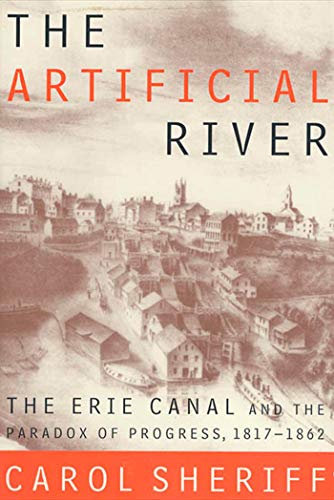
For readers who want the strongest next step, start with The Artificial River by Carol Sheriff. It is a clear-eyed history of the Erie Canal that focuses on the social and economic transformation the canal produced — including both the commercial opportunities it created and the disruptions and dislocations that came with redirecting the geography of American growth.