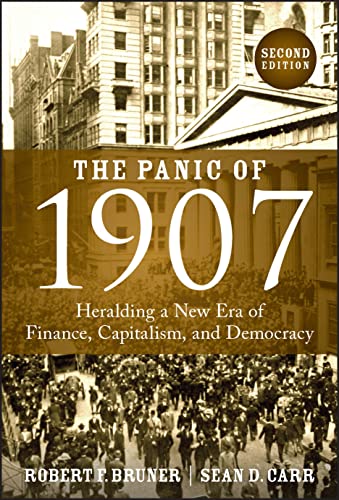
A bank run is not only a liquidity event. It is a brutal referendum on whether the public believes the system beneath the marble facade is real. On the morning of October 22, 1907, several thousand depositors lined up outside the Knickerbocker Trust Company on Fifth Avenue in New York City, and what they did over the next few hours changed American finance more permanently than any single market crash ever could.
The Knickerbocker was not an obscure institution. It was one of the largest trust companies in the country, with over $62 million in deposits and a membership roll that read like a directory of New York’s social elite. Its president, Charles T. Barney, moved in the same circles as J.P. Morgan, James Stillman, and the rest of the men who effectively governed American capital. Which is precisely why its collapse was so destabilizing — because if the Knickerbocker could fail, any trust company could fail, and nobody could say with confidence which ones held similar hidden exposure.
The run mattered because it made invisible leverage suddenly visible in the most public way possible. Hidden Fortunes is interested in the deeper layer: how confidence fragility, trust-company leverage, collateral doubts, and run dynamics inside an under-protected financial system became the mechanism that transformed a localized failure into a systemic panic — and why the same structural pattern keeps reappearing in modern finance, infrastructure, and credit markets.

The World Before the Fortune
Trust companies were the shadow banking system of the Gilded Age. Unlike nationally chartered banks, they operated under far looser state regulations, maintained minimal cash reserves, and were permitted to invest in equities, real estate, and speculative ventures that commercial banks were forbidden to touch. By 1907, trust companies in New York City collectively held nearly $1 billion in deposits — roughly a third of all banking resources in the state — and much of that money was deployed in ways that would never survive serious scrutiny.
The system had grown larger and riskier than its safeguards. The National Banking Act of 1863 created a two-tier structure: nationally chartered banks held reserves, submitted to federal examination, and could access the clearinghouse system during crises. Trust companies, operating under state charters, did none of these things reliably. They paid higher interest on deposits, took on riskier assets to generate that yield, and operated on the assumption that their wealthy depositor base would remain calm even when markets turned.
That assumption was always fragile. What made 1907 especially dangerous was a convergence of pressures: a severe monetary contraction following the San Francisco earthquake of 1906 had drained credit reserves, copper market speculation had drawn several prominent trust company officers into dangerously leveraged positions, and the stock market had been declining steadily since early in the year. The system was primed. The Knickerbocker simply provided the match.
Fortunes, and disasters, become historic not because one institution made one bad bet, but because the surrounding system kept rewarding the same kind of leveraged behavior repeatedly. When confidence in one prominent institution cracked, the public and the market began treating other hidden exposures as potentially similar — even before full information existed to confirm the fear.

The Rise of the Run
The trigger was a failed corner in copper. Charles Barney had financed Augustus Heinze and Charles Morse — two speculators who attempted to squeeze the copper market in early October 1907. When the corner collapsed and Heinze’s Mercantile National Bank came under pressure, clearinghouse members moved quickly to expel the connected institutions. Barney, as a close associate of Morse, became radioactive almost overnight.
On the morning of October 22, the National Bank of Commerce announced it would no longer honor Knickerbocker checks for clearing. That single announcement, reported immediately in the afternoon papers, was enough. Depositors began arriving at the Fifth Avenue branch before it opened the next morning. By 10 a.m., the line stretched down the block. By noon, the bank had paid out roughly $8 million. By 1:45 p.m., it suspended operations entirely, having exhausted its available cash.
The collapse became important because it compressed fear into a public image everyone could understand: depositors in motion, support evaporating, and a supposedly solid institution suddenly looking doubtful. Photographs of the queue circulated in newspapers across the country within hours. The visible move mattered, but the deeper dynamic was more structural — once one institution failed this publicly, the question every depositor in every trust company had to answer was whether their institution held similar hidden exposure. Most of them could not answer confidently. That uncertainty was more dangerous than the Knickerbocker’s failure itself.

The Expansion of Panic
Trust runs are contagious in a way that commercial bank runs are not, precisely because trust companies had no clearinghouse support, no federal safety net, and no standardized examination process that would allow outside observers to distinguish between sound and unsound institutions quickly. The Knickerbocker’s failure immediately put pressure on the Trust Company of America and the Lincoln Trust, both of which faced deposit withdrawals within 48 hours.
This is where J.P. Morgan’s intervention becomes legible. Morgan organized a private rescue not because he was philanthropically inclined, but because he understood that panic does not stop at institutional boundaries once it achieves momentum. The Morgan guarantee mechanism that stabilized Trust Company of America over the following days worked precisely because it provided the one thing a run destroys: credible assurance that liquidity would be available before a depositor reached the teller window.
The episode also accelerated the conversation that Paul Warburg and others had been pushing for years: that the United States needed a central bank capable of acting as a lender of last resort. The Panic of 1907 became the founding argument for the Federal Reserve Act of 1913. The mechanism that allowed later failures like Lehman Brothers to spread so rapidly in 2008 — hidden leverage, asset opacity, institutional interconnection — was already clearly visible in 1907. The system absorbed the lesson slowly.
This is where wealth stops looking transactional and starts looking institutional. Instead of relying on one breakthrough, the system begins reproducing power through governance, infrastructure, finance, regulation, or repeated dependency. The Knickerbocker episode turned the Panic of 1907 from a macro story into a more exact lesson about how confidence transmission works when hidden leverage has already accumulated beneath the surface.

The Hidden Strategy Behind the Collapse
The hidden strategy behind the Knickerbocker’s vulnerability was not incompetence. It was the same strategy that had made trust companies attractive in the first place: using loose regulatory constraints to pursue higher yields through riskier assets, and maintaining just enough reputation among wealthy depositors to keep the funding base stable. That strategy worked brilliantly in calm conditions. It became catastrophic the moment one prominent officer’s external connections attracted public scrutiny.
What the collapse exposed was not merely one institution’s weakness. It exposed the entire architecture of confidence that trust companies depended on. Trust companies had no deposit insurance, no federal examination, no clearinghouse membership, and no guaranteed access to emergency liquidity. What they had instead was reputation — and reputation is the most fragile form of capital in existence because it can evaporate faster than any institution can organize a defense.
That matters because the public version of the story usually overemphasizes the most visible asset and underestimates the discipline beneath it. The real source of staying power — or in this case, systemic fragility — was the ability to make the surrounding system behave in a more predictable and profitable way. When that ability disappeared in a single afternoon, $8 million in deposits followed it out the door before the bank could mount any response at all.
The lasting lesson is about how confidence fragility, trust-company leverage, collateral doubts, and run dynamics inside an under-protected financial system became a lever strong enough to outlive one cycle, one technology, or one political mood. That same architecture appears in every financial crisis where opacity, interconnection, and institutional dependency combine to make a localized failure into a systemic one.

The Cost, the Risk, and the Collapse
Charles Barney resigned his presidency on October 23 and died from a self-inflicted gunshot wound six weeks later. The Knickerbocker Trust did not fully reopen until March 1908, after Morgan and a consortium of banks organized a structured rescue. Depositors eventually recovered most of their funds, but the intervening months of frozen assets and uncertainty destroyed businesses, derailed payrolls, and cascaded through the real economy in ways that official tallies never fully captured.
The damage extended beyond one institution because a run changes expectations. Once people believe support may arrive too slowly, they begin behaving in ways that make fragility more real. The very act of queuing at Knickerbocker taught other depositors elsewhere that queuing was rational — because being first in line at a failing institution is better than being last. That self-reinforcing logic is why systemic panics are so difficult to stop once they achieve momentum.
Every powerful financial system carries the same vulnerability. The mechanism that creates efficiency, dominance, or credibility can also create concentration, backlash, brittleness, or catastrophic feedback. Trust companies had built a model that depended on calm — and calm, once broken, cannot be restored by the same institution that lost it.
Lessons for Modern Business Readers
1. Control the hidden layer, not just the visible one
The deepest leverage usually sits below the visible product. Trust companies held power through regulatory arbitrage and reputation management, not through the quality of their assets. When the hidden layer was exposed, the visible facade collapsed in hours. In modern terms: products matter, but chokepoints, credit arrangements, and institutional dependencies matter more.
2. Opacity is leverage until it becomes liability
Trust companies used asset opacity to maintain depositor confidence and pursue higher yields. That same opacity prevented outside observers from distinguishing sound from unsound institutions during the panic, which is why the run spread beyond the Knickerbocker itself. Opacity compounds advantage in calm markets and compounds fear in stressed ones.
3. Reputation is the most fragile capital
The Knickerbocker’s failure took less than 24 hours from announcement to suspension. Its reputation had been built over decades. Confidence is not rebuilt on the same timeline it is destroyed — and the asymmetry between those two speeds is the most dangerous structural feature of any institution that depends on public trust.
4. Infrastructure beats improvisation
J.P. Morgan’s rescue worked because he had pre-existing relationships, institutional authority, and personal credibility that could be deployed faster than panic spread. Institutions without that infrastructure — clearinghouse membership, central bank access, reserve requirements — had no equivalent mechanism to call on. Long-run advantage comes from building the route before the crisis, not scrambling to build it during.
5. Interconnection multiplies both scale and fragility
The copper speculation that brought down Barney was conducted through a network of interconnected institutions, each of which held some exposure to the others. When one node failed, the network transmitted fear rather than absorbing it. Modern financial systems with complex derivative exposures and counterparty dependencies are structurally identical to this — scale has increased, but the basic mechanism has not changed.
6. Study mechanism, not mythology
The point of the Knickerbocker story is not the drama of the queue or the tragedy of Charles Barney. It is the underlying machine: how confidence transmission works when hidden leverage has already accumulated, how institutional architecture shapes who survives a crisis and who does not, and how the same structural pattern keeps reappearing across different eras and different asset classes.
Conclusion
The Knickerbocker Trust Collapse is a story about confidence, leverage, and the gap between an institution’s public image and its actual structural resilience. A bank run reveals that gap in the most public and irreversible way possible — and once revealed, the information cannot be un-revealed. Every trust company depositor in New York City had to update their assessment of their own institution in the hours after Knickerbocker suspended, and many of them concluded that the rational move was withdrawal.
That cascade logic is the real mechanism this article is about. It explains why systemic panics are not simply the sum of individual institutional failures. They are episodes in which hidden leverage, confidence fragility, and institutional opacity combine to make localized failure into distributed fear — and distributed fear into real economic contraction.
For modern readers, the practical payoff is immediate. The same structural conditions — opacity, interconnection, leverage, and dependence on confidence rather than verifiable resilience — appear in every financial crisis from 1907 to 2008 to the next one still forming. Understanding the mechanism in its clearest historical form makes later examples easier to recognize before they reach the queue-on-the-sidewalk stage. That is what Hidden Fortunes is for: not admiration for great names, but training the eye to spot the underlying machine while there is still time to think clearly about it.