Sometimes a financial system reveals its true structure only when it panics.
In 1907, America learned that its structure still depended too heavily on one private man. J.P. Morgan gathered financiers, assessed weakness, and forced action in a crisis that threatened to widen without a formal central bank. The spectacle looked impressive. It was also a warning.
That warning is what makes the episode a Hidden Fortunes story. Morgan’s power was real, but the deeper meaning lay in what the country lacked.
The World Before the Fortune

America’s pre-Federal Reserve banking system was powerful but fragmented. Reserves were dispersed, seasonal pressures could become acute, and market trust could vanish quickly when institutions looked weak. The system could generate growth, but it struggled to generate calm on command.
In such an environment, crises did not wait politely for legislative design. They spread through rumor, withdrawals, and fear. The practical question was always who could impose order fast enough to stop panic from feeding on itself.
That is why Morgan mattered. The Baring Crisis of 1890 had already shown how quickly private bank weakness could threaten systemic collapse. America’s version of that lesson was still coming.
The Rise

Morgan’s authority in 1907 did not come out of nowhere. It had been built over years of industrial finance, railroad restructuring, government interaction, and the cultivation of an elite reputation strong enough to make others accept his judgment under pressure.
By the time panic intensified, that reputation functioned like emergency infrastructure. Bankers, trust-company executives, and market participants believed Morgan could distinguish salvageable institutions from terminal ones and could pressure the right players to support a rescue.
This is what made the “panic room” dynamic possible. A private library became a command center because the financial world had already accepted Morgan as one of the few men who could turn fear into hierarchy.
The Expansion of Power

Once Morgan began coordinating the response, the crisis became a test of concentrated authority. Private capital had to be mobilized. Weak institutions had to be assessed. Cooperation had to be extracted from actors who might otherwise hoard liquidity and wait for someone else to bear the cost.
Morgan’s method was effective precisely because it was personal and coercive. He did not need a public committee to deliberate for weeks. He needed enough status to close the room, demand numbers, and force the city’s most important men to act in the name of systemic preservation.
That speed was the great virtue of the model. It was also the great indictment of the system. If one private banker must behave like a national monetary authority, then national monetary authority does not yet truly exist.
The Hidden Strategy Behind the Fortune

The hidden strategy behind the fortune was private central banking through trust networks.
Morgan could stop panic because the market believed his judgment, his relationships, and his command of elite cooperation were stronger than the centrifugal pull of fear. In practical terms, he acted like an emergency lender, coordinator, and political broker at once, even without formal public office.
This is the strategic significance of the episode. The story is not only that Morgan was brilliant. It is that concentrated trust can substitute for missing institutions for a time. That substitution is incredibly powerful and inherently unstable.
Paul Warburg and later reformers understood that point. Morgan’s success in 1907 was part of the argument for why America needed something more durable than Morgan.
The Cost, Risk, or Collapse
The cost of this rescue model was political and structural. A republic that depends on one private financier to stabilize its economy has outsourced public safety to private hierarchy. That may work in a narrow emergency. It is a dangerous long-term arrangement.
There was also a practical cost. Private rescue depends on the willingness, health, and judgment of individuals who cannot be guaranteed forever. Institutions exist precisely because charisma and private prestige do not scale indefinitely.
That is why the Panic of 1907 is important even beyond Morgan’s success. The rescue was impressive. The need for it was an indictment.
Lessons for Modern Business Readers
1. Trust can become emergency infrastructure
In a weak system, the person trusted by everyone can temporarily substitute for the institution missing from the design.
2. Fast authority matters in panic
When fear compounds hourly, slow governance can be fatal. Crisis systems need clear decision rights.
3. Private heroics reveal public weakness
A rescue can stabilize the market while also proving that the system depends on something dangerously informal.
4. Leadership without structure does not scale
One remarkable operator can buy time. He cannot replace a durable architecture forever.
5. Crisis episodes create reform windows
Once a panic makes institutional weakness undeniable, new designs become politically possible.
6. Power is clearest when it can force coordination
Morgan’s real advantage was not only capital. It was the ability to make other powerful people move together.
Book Recommendation
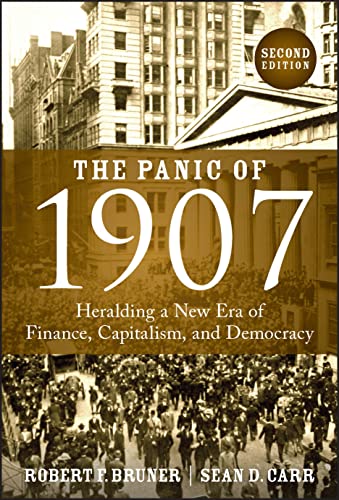
For readers who want the best next step, start with The Panic of 1907: Heralding a New Era of Finance, Capitalism, and Democracy by Robert F. Bruner and Sean D. Carr. It is the right follow-up because it gives readers a focused, readable account of the crisis itself — how it unfolded, how Morgan responded, and what it meant for the future of American finance.