The most persuasive capital story is often the one that contains enough truth to hide how early the money arrived.
In the 1840s, British investors poured capital into railway schemes faster than routes could be surveyed, let alone built. The technology was real. The demand was real. And yet the financial damage was severe enough to rewrite the rules of British corporate law. Railway Mania was not a delusion — it was a timing problem dressed up as a valuation problem.
The AI data-center boom raises a structurally similar question. The technology is real. The demand projections are plausible. The money is arriving faster than utilization rates can be proven. Whether that produces a durable wealth transfer or a sharp correction depends on a mechanism Hidden Fortunes has seen before: the gap between the truth of the long-term story and the discipline of the near-term capital allocation.
This comparison is not a bubble call. It is a framework for thinking about when infrastructure narratives attract capital before demand economics have fully matured — and what that timing gap has historically meant for investors, builders, and the fortunes that emerged on the other side.
The World Before the Fortune

Infrastructure revolutions almost always attract more money than the first wave of sober economics can justify. That does not mean the technology is fake. It means markets are pricing a future before cash flow, bottlenecks, and demand discipline have fully matured.
In the 1840s, Britain was industrializing rapidly. Steam power had already transformed manufacturing. The logic of extending it to transport was compelling and directionally correct. What investors mispriced was not the destination but the timing: how many routes would actually generate returns, how long the build-out would take, and what the competitive dynamics among rival lines would look like once the network densified.
The Railway Mania period saw Parliament authorize hundreds of new lines, many of which were promoted by the same financial interests that stood to profit from the authorization itself. Capital was cheap, the narrative was powerful, and the structural check on over-investment — demonstrated demand at profitable prices — had not yet arrived.
The surrounding environment rewarded anyone who could organize speculative infrastructure finance, demand timing, and the conversion of narrative into capital flow more effectively than rivals. Once that happened, what looked like momentum on the surface started behaving more like architecture underneath.
The Rise

Railway Mania showed how a compelling infrastructure promise could pull huge amounts of capital into projects before investors really knew which routes would earn durable returns. The AI data-center boom raises a version of the same timing problem.
AI data centers are now among the largest single infrastructure investments on earth. Hyperscalers are spending hundreds of billions of dollars on compute capacity, power infrastructure, and cooling systems — before the revenue models that will use that capacity have fully matured. The logic is sound: AI workloads will grow. The question is whether the scale and timing of the current buildout is matched to actual near-term demand or to a five-year narrative.
Capital rushes fastest when a story is directionally right but financially under-specified. Railway promoters in the 1840s were not lying about the future. They were leveraging the credibility of a genuine technological revolution to attract capital faster than the economic reality could absorb. The AI infrastructure buildout has similar properties.
Oracle’s AI debt positioning illustrates how seriously financial actors are treating the long-term AI infrastructure thesis. The money is not speculative in the sense of irrational — but the quantity and speed of deployment raises the same question that faced Railway Mania investors: who benefits most when the dust settles?
The Expansion of Power

The comparison is strategically useful because it helps Hidden Fortunes readers avoid two lazy conclusions at once: that all enthusiasm is irrational, or that all transformative infrastructure deserves any price investors are willing to pay.
Railway Mania ended badly for many equity investors. But the railways themselves were built. Britain’s economic geography was permanently reshaped. The fortunes that endured were not those held by the original promoters, who often lost everything in the correction, but by those who acquired productive assets at distressed prices after the mania collapsed.
The structural question for AI infrastructure is similar. Even if current data-center valuations are stretched, the physical infrastructure being built — the power substations, the fiber networks, the cooling systems, the compute clusters — will likely remain productive assets for decades. The question is not whether the infrastructure matters. It is who will own it, at what cost basis, and under what terms.
Markets reward product innovation, but they often reward infrastructure control even more. The actor who controls the route, the financing, the settlement layer, the data pipe, or the regulatory gateway usually has the better long-term position. Railway history suggests this is true even after a speculative episode — the infrastructure survivors, not the speculators, often capture the durable returns.
The Hidden Strategy Behind the Fortune

The hidden strategy behind the fortune was using a nineteenth-century rail bubble to explain how modern infrastructure narratives can attract capital before demand economics fully settle.
In Railway Mania, the actors who profited durably were not primarily the equity investors who bought railway shares at the peak. They were the engineers who accumulated expertise that remained valuable regardless of which specific lines succeeded, the landowners who extracted high prices for right-of-way, and eventually the consolidators who bought distressed assets cheap once the speculative episode collapsed.
The same logic appears in AI infrastructure today. The bond market, not the equity market, may be making the more sophisticated bet — lending against physical assets at predictable yields rather than pricing exponential growth into common equity. The financial structure matters as much as the infrastructure narrative.
In Hidden Fortunes terms, the deeper lesson is not whether to invest in AI infrastructure. It is to understand which layer of the system captures durable value — and whether the current capital flows are going to the right layer at the right price.
The Cost, Risk, or Collapse
When infrastructure narratives outrun financing discipline, the eventual damage can hit lenders, equity holders, builders, and the credibility of the entire theme.
Railway Mania’s collapse did not destroy the railway industry. It destroyed the financial structures built around the industry during the speculative phase. Share prices collapsed, dozens of promoters went bankrupt, and Parliament tightened corporate law significantly. But trains kept running, and the underlying infrastructure continued to generate economic value for a century.
The risk in the AI data-center boom is less that the technology fails and more that capital deployment runs so far ahead of monetizable demand that the correction, when it comes, creates significant losses for investors who bought the narrative rather than the assets. The comparison to Railway Mania is useful precisely because it shows that a true story can still produce a false valuation.
Hidden Fortunes should feel researched, intentional, historically grounded, and sober about uncertainty. The AI buildout may prove exactly as productive as the most optimistic projections suggest. Or the timing gap between infrastructure investment and demand realization may be wide enough to produce a meaningful financial episode. Both outcomes are consistent with the historical pattern.
Lessons for Modern Business Readers

1. Directional truth is not the same as financial discipline
Railway Mania investors were right about the long-term importance of railways. They were wrong about near-term returns. AI infrastructure investors may be right about the long-term importance of compute. The gap between the narrative and the financial reality is where the risk lives.
2. The corrective phase can create the best entry points
The fortunes built on Railway Mania infrastructure were often made not during the mania but after it. Distressed asset acquisition, at prices that reflected the collapsed narrative rather than the durable economic value, produced more durable returns than peak-cycle equity ownership.
3. Follow the bond market, not just the equity market
Railway bondholders often fared better than equity holders during and after the mania. In AI infrastructure, the financial structure of each deal — who holds senior claims on physical assets versus who holds exposure to narrative-dependent growth — is as important as the underlying technology thesis.
4. Infrastructure expertise outlasts the speculative episode
The engineers, operators, and financial advisors who accumulated real expertise in railway finance became valuable precisely because that expertise survived the mania. The same principle applies to AI infrastructure: domain expertise in power engineering, cooling systems, and data-center operations has durable value regardless of which specific financial structures succeed.
5. Translate history into operating logic
The point of studying Railway Mania is not to declare every technology buildout a bubble. It is to build a framework for evaluating when narrative-driven capital flows are running ahead of demonstrable demand — and to recognize that pattern before it becomes obvious.
Conclusion
Seen clearly, this is not just a story about the structural parallel between rail speculation and AI infrastructure enthusiasm. It is a story about a repeating pattern in how transformative technologies attract capital — and how the fortunes made during that process depend less on being right about the technology than on being right about the financial structure, the timing, and the layer of the system that captures durable value.
That is why the article exists inside the Hidden Fortunes ecosystem. It reinforces the Financial Crises cluster with a mechanism that applies directly to modern infrastructure investing — giving readers a sharper framework for evaluating the AI buildout without reducing it to either cheerleading or contrarianism.
Book Recommendation
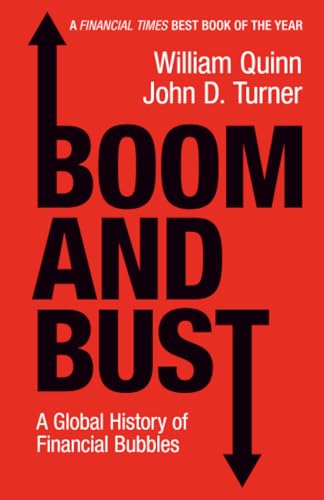
For readers who want the strongest next step, start with Boom and Bust: A Global History of Financial Bubbles by William Quinn and John D. Turner. It is the right follow-up because it documents exactly how capital flows, regulatory responses, and asset valuations played out during Britain’s defining infrastructure speculation — in the precise detail that makes the modern parallel useful rather than superficial.