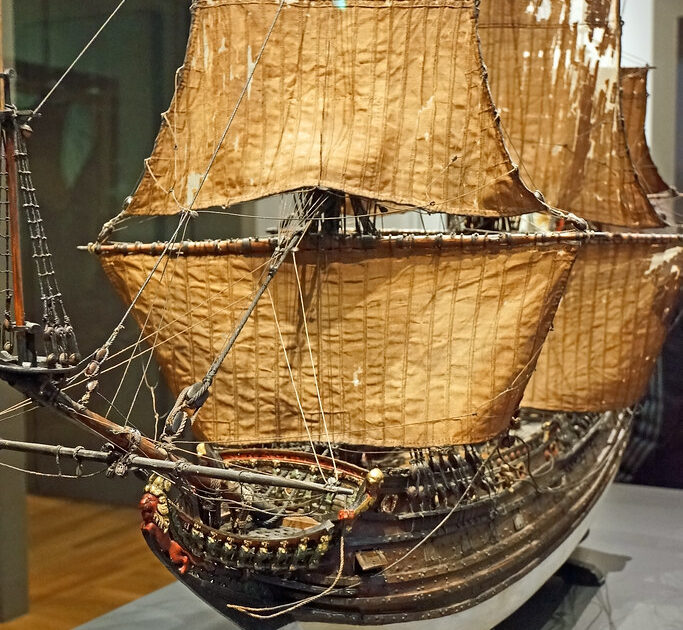
Some inventions are mechanical. Others are legal and financial. The joint-stock company changed history by redesigning how capital could remain committed.
Before the joint-stock company became standard corporate form, the most common way to finance a long-distance trading voyage was the commenda — a partnership formed for a single voyage that dissolved upon return. A merchant and an investor would pool funds, send a ship, and divide the proceeds when it came back. The system worked for individual voyages, but it created an impossible problem for the scale of enterprise that building a true commercial empire required.
When the East India Company and the VOC went head to head, both were deploying something the commenda model could never have supported: a permanent capital structure that allowed the enterprise to operate fleets, maintain warehouses, negotiate treaties, and fight wars across multiple continents simultaneously. The joint-stock invention was the financial prerequisite for that scale.
The banking systems that powered European empires provided credit, but credit alone cannot fund a twenty-year project like establishing a durable commercial presence in Asia. What was needed was capital that would stay — that could not be withdrawn every time a voyage returned. The joint-stock company solved this problem through a legal fiction that turned out to be a financial revolution.
The World Before the Fortune

Long-distance trade and imperial projects were too risky, too slow, and too expensive for many older financing models. The breakthrough came when capital could become more durable, claims more transferable, and ventures less dependent on one voyage at a time.
The problem with the commenda model was temporal. A voyage to the East Indies took eighteen months to two years. Capital was tied up for that entire period, generating no returns until the ship came back. If the ship was lost, the capital was gone. If it returned with a profitable cargo, the partnership dissolved and new capital had to be assembled for the next voyage.
This meant that each voyage was essentially a new business. There was no continuity of organization, no ability to invest in permanent infrastructure like warehouses or forts, no way to develop relationships with Asian trading partners that would persist beyond a single transaction. The enterprise could not grow beyond what a series of one-off voyages could accomplish.
The environment that produced the joint-stock solution was one of expanding commercial ambition encountering the limits of existing financial form. Dutch merchants in the early seventeenth century were competing with Portuguese and Spanish enterprises that had state backing and were attempting to monopolize Asian trade routes. Competing required scale. Scale required capital that could remain organized for years rather than months.
The Rise

The joint-stock model mattered because it let investors participate in scale without forcing the whole project to liquidate whenever one cycle ended. That gave corporate empires a stronger financial spine.
The VOC’s 1602 charter solved the temporal problem through a radical legal move: instead of promising to return capital at the end of each voyage, the charter committed investors’ capital for a period of ten years, with shares that could be sold to other investors in the meantime. Capital was no longer tied to a specific voyage — it was tied to the enterprise itself.
The secondary market that developed for VOC shares in Amsterdam was the first genuine stock market — a place where investors could convert their shares to cash without requiring the company to liquidate assets. This transferability made permanent capital politically viable: investors who needed liquidity could sell, without disrupting the company’s operations.
The VOC’s dividend policy reinforced this structure. By distributing profits as dividends rather than returning capital, the company maintained its permanent capital base while still rewarding investors. The innovation was conceptually simple but organizationally profound: separate the return of profits from the return of capital.
The Expansion of Power

That is why this article belongs in the Hidden Fortunes ecosystem. It reveals the mechanism beneath multiple empire stories already in the archive and turns them into one more coherent financial lineage.
What permanent capital enabled was institutional continuity. The VOC could invest in forts along the Malabar Coast, knowing that those forts would still be company assets a decade later. It could develop relationships with local rulers in the spice islands, knowing that the company official who made the agreement would be replaced by another company official with the same mandate rather than a dissolved partnership. It could train specialists, develop information networks, and accumulate geographic knowledge in ways that a voyage-by-voyage enterprise could never match.
The Dutch East India Company became the first genuinely multinational company in history — not just a trading enterprise, but an organizational form with its own legal standing, its own capacity to make treaties, and its own ability to use force. These capabilities required a financial structure that could sustain them over decades. Joint-stock permanent capital was the enabling condition.
The English East India Company followed the same model, eventually. Its early history involved separate joint stocks for each voyage, but it gradually moved toward a permanent capital structure that allowed it to build the same kind of institutional presence that the VOC had established. The competition between them was ultimately a competition between organizational forms as much as between trading strategies.
The Hidden Strategy Behind the Fortune

The hidden strategy behind the fortune was using permanent capital to fund long-distance, high-risk ventures that no short-term financing model could scale as effectively.
The insight at the core of the joint-stock invention was that the right unit of financial organization was not the voyage but the enterprise. The enterprise could accumulate knowledge, relationships, infrastructure, and political connections over time in ways that a series of individual voyages could not. Once capital was organized at the enterprise level rather than the voyage level, the scale advantages compounded.
This compounding worked across multiple dimensions. The company that maintained a continuous presence in Asian ports learned which routes were reliable, which local rulers were trustworthy, which cargoes commanded premium prices. It could negotiate long-term supply arrangements. It could make the investments in naval and military capability required to protect its routes. All of these required continuity that only permanent capital could provide.
The lasting lesson is about how permanent capital, transferable claims, legal continuity, and high-risk imperial venture finance became a lever strong enough to outlive one cycle, one product, or one charismatic figure. The VOC outlasted the careers of every individual who worked for it. That institutional durability was the joint-stock invention’s most important contribution.
The Cost, Risk, or Collapse
Permanent capital made empire more scalable, but it also made extraction more durable. Once a machine can outlive a voyage, it can institutionalize harm more effectively as well as profit.
The organizational durability that joint-stock permanent capital provided was not morally neutral. The VOC used its continuous institutional presence to enforce trade monopolies through violence, to manipulate local political structures, and to extract commodities at prices that enriched shareholders in Amsterdam while impoverishing producers in Asia. These activities were sustainable precisely because the organization outlasted the individuals who committed them.
The EIC’s eventual transformation into a governing body over much of India — collecting taxes, administering justice, maintaining armies — was a direct consequence of the organizational permanence that joint-stock capital had created. An enterprise with a temporary capital structure could not have accumulated the political power that a permanent institution could. The joint-stock form enabled the EIC to be something more than a trading company.
The Bank of Amsterdam provided the settlement infrastructure that made large-scale VOC operations financially tractable. The combination of a permanent corporate form with a reliable settlement institution created a financial ecosystem in which the scale of VOC operations became possible and profitable.
Lessons for Modern Business Readers

1. The unit of organization determines what is possible
The shift from voyage-level to enterprise-level organization was not just administratively convenient. It changed what was financially possible. The same principle applies in modern business: organizing capital at the right level — product, business unit, company, or ecosystem — determines what kinds of investments and what time horizons become viable.
2. Permanence requires transferability
Investors accepted permanent capital commitments because the share could be sold. Without secondary market transferability, permanent capital would have been politically unacceptable — investors cannot commit indefinitely to a project with no exit. Modern private markets have developed analogous solutions: secondary markets for private equity, liquidity provisions in venture structures, and public listings all serve the function of making permanent capital acceptable to investors.
3. Institutional knowledge compounds over time
The VOC’s advantage over voyage-by-voyage competitors grew over time because it could accumulate and preserve knowledge — about routes, counterparties, products, and political relationships — in ways that temporary partnerships could not. Modern companies face the same dynamic: organizational memory and accumulated expertise are assets that compound over time if the institution persists.
4. Legal form is a strategic choice
The joint-stock company was a legal invention before it was an economic success. The choice of legal form — partnership, corporation, LLC, cooperative, public benefit company — determines what kinds of capital you can raise, what governance structures you can implement, and what time horizons become viable. These are strategic choices with long-term consequences.
5. Institutional permanence has costs as well as benefits
The VOC’s permanence made it more effective as a commercial enterprise and more dangerous as a political actor. Organizations that outlast their original purposes can become self-perpetuating in ways that harm the broader system. The history of chartered companies is partly a history of organizational permanence enabling extraction that temporary enterprises could never have sustained.
Conclusion
Seen clearly, this is not just a story about the joint-stock company as a legal form. It is a story about how financial innovation enables organizational innovation — and how the right combination of capital structure, legal form, and market infrastructure can create enterprises capable of operating at scales and time horizons that previous organizational forms made impossible.
That is why the article belongs inside the Hidden Fortunes ecosystem. It provides the financial mechanism behind the EIC-VOC rivalry, the VOC dividend story, and the broader empire-finance cluster — turning a collection of individual company stories into a coherent account of how permanent capital changed the scale of what commerce could accomplish.
Book Recommendation
For readers who want the strongest next step, start with The Corporation That Changed the World by Nick Robins. It is the definitive critical account of the East India Company — showing how the joint-stock model was used to build both the most sophisticated commercial enterprise of its age and one of the most consequential systems of extraction in history.
