Industrial empires like to tell their story in steel, scale, and genius. Workers remember the gates.
By the time the Homestead Strike exploded in 1892, Carnegie’s steel machine already looked like one of the great achievements of the American Gilded Age. But large systems reveal themselves most honestly under pressure. Homestead showed what happened when labor stopped being a cost line and became an obstacle to throughput, authority, and profit.
That is why the strike matters for Hidden Fortunes. The real story is not only that violence happened. It is that violence exposed a business model in which labor peace was valuable only as long as it served the machine.
The World Before the Fortune

Late nineteenth-century steel was a brutal business. Prices moved, demand surged, technology advanced, and scale rewarded the operators who could keep furnaces hot, costs low, and supply dependable. Carnegie’s rise depended on more than ambition. It depended on building an integrated production system fast enough and efficiently enough to dominate rivals.
But integrated industrial systems create a strategic problem. The more a company depends on continuous output, the less tolerance it has for labor disruption. A blast furnace cannot be managed like a shop counter. Delays are expensive, shutdowns are dangerous, and worker bargaining can become strategically threatening if too much of the machine’s timing depends on human resistance or cooperation.
That is the world behind Homestead. It was not simply a disagreement over wages. It was a conflict between industrial capital seeking uninterrupted control and labor seeking enough leverage to avoid being treated as a disposable variable inside a giant production machine. Understanding how Carnegie used vertical integration to build that machine makes the conflict that much easier to read.
The Rise

Carnegie’s steel empire had already demonstrated the rewards of integration, discipline, and scale. Henry Clay Frick, Carnegie’s hard-edged lieutenant, embodied the more ruthless side of that system. Where Carnegie liked the language of uplift and progress, Frick specialized in enforcement. He understood that a modern industrial empire could not depend on persuasion alone when output and managerial control were at stake.
At Homestead, contract negotiations deteriorated into a direct confrontation. Frick moved to break union power, fortify the plant, and protect management’s freedom to run the works on its own terms. That choice did not emerge from personal hostility alone. It emerged from strategic logic. A company that yields too much control at a critical site risks inviting similar challenges elsewhere.
The strike thus became a test of who really governed the machine. Were workers partners in an industrial order, or merely inputs to be disciplined when they became inconvenient? The answer the company gave was severe and unforgettable.
What contemporaries often missed was the compounding effect of the mechanism itself. Once the Homestead conflict exposed how industrial efficiency was not only built through furnaces and integration, but through labor discipline enforced hard enough to protect throughput and bargaining power, every later decision became easier to understand. The institution at the center of this story did not need to win every battle in dramatic fashion. It needed to make rivals operate on worse terms, make allies depend on its system, and make the surrounding market feel natural only after its own structure had already become dominant.
The Expansion of Power

The famous violence around Homestead, including the clash involving Pinkerton agents, exposed how quickly labor conflict could become national theater. What looked like a local management dispute became a referendum on the moral cost of industrial modernity. Yet from a narrow strategic viewpoint, the company also signaled something important: it was willing to absorb outrage rather than concede operational sovereignty.
That willingness mattered because empires often become stronger after showing what kinds of resistance they will crush. Even when reputational damage follows, the internal message to capital markets, competitors, and future labor opponents can be clear. The machine will run, and management will decide the terms under which it runs.
Homestead therefore belongs inside the industrial strategy conversation, not outside it. The conflict did not interrupt the business model from a distance. It illuminated the coercive boundary conditions that helped the business model hold together at scale.
The Hidden Strategy Behind the Fortune

The hidden strategy behind the fortune was labor discipline in service of throughput.
Carnegie’s steel system is often remembered for integration, cost control, and managerial sophistication. Those were real. But Homestead shows the part of the strategy that cleaner business histories soften: when labor organization threatened the pace, flexibility, or authority of the machine, management treated suppression as a strategic necessity.
This is why the strike matters beyond moral judgment. It helps explain how some industrial fortunes became so durable. The machine was not only well designed. It was defended. Frick’s role makes visible a pattern that appears across empire history: once a system becomes valuable enough, some leaders decide that coercion is cheaper than compromise.
For modern readers, the lesson is not that violence defines every business system. It is that operating efficiency can hide the governance choices underneath it. If output remains smooth, outsiders may never ask what kind of pressure keeps it smooth. The same logic appears in a different form when you study how Ford used wages as a control mechanism a generation later — discipline takes different shapes depending on the era.
The Cost, Risk, or Collapse

The human cost was obvious. Workers died. Communities fractured. The moral legitimacy of industrial progress took a public wound. Even Carnegie, who was not physically present at Homestead, could not fully escape the stain because the violence fit too neatly inside the economics of the empire he had built.
There was a deeper cost too. Once companies normalize the idea that labor resistance is a threat to be broken rather than a signal to be negotiated, they may preserve short-term control while poisoning long-term trust. The machine survives, but the social contract around the machine deteriorates.
That tension is one reason Homestead still matters. It shows that business brilliance can coexist with institutional brutality, and that an empire’s efficiency statistics rarely tell the whole story of how the empire actually functions.
The danger in stories like this is that success can make the system look cleaner than it really was. Once a mechanism begins to work, observers often mistake temporary dominance for inevitability. But fortunes built through Industrial Empires logic still face execution risk, political reaction, human resistance, and the possibility that the very technique that created power will later attract scrutiny or overreach. That is why disciplined readers should study not only the ascent, but the stress points hidden inside the ascent.
Lessons for Modern Business Readers

1. Operational excellence has governance underneath it
If a system runs smoothly, ask what kind of authority, incentive, and pressure keeps it running that way.
2. Bottlenecks make labor strategically important
The more a company depends on uninterrupted throughput, the more leverage labor conflict can gain — and the harder management may fight to suppress it.
3. Reputation can diverge from operating reality
Carnegie’s public image and Frick’s enforcement role show how empires can split moral branding from practical control.
4. Coercion can protect efficiency, but at a cost
Suppressing resistance may stabilize output in the short term while deepening political, moral, and reputational risk.
5. Systems thinking must include human cost
A serious business reader should study not only how an empire scales, but who absorbs the pain of that scale.
6. The cleanest business narratives often hide the dirtiest mechanisms
When a fortune looks too elegant on the surface, the missing story is often buried in labor, logistics, or enforcement. The same pattern emerges when you examine how Ford’s River Rouge complex tried to own the entire industrial world — scale and control go together until the human cost makes them impossible to ignore.
Book Recommendation
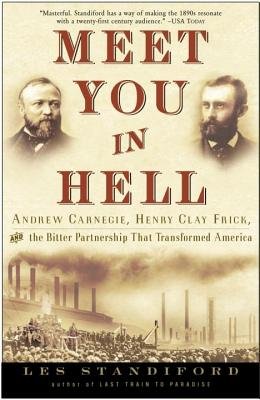
For readers who want the best next step, start with Meet You in Hell by Les Standiford. It is the right follow-up because it helps extend the strategic logic behind this article without flattening the historical complexity. Standiford traces the bitter partnership between Carnegie and Frick from friendship to irreparable rupture, using Homestead as the turning point that exposed what each man was really building.