In industrial history, higher wages are often remembered as moral progress. In Ford’s case, they were also a weapon.
The five-dollar day became famous because it looked dramatic and generous against the labor standards of its time. But Henry Ford was not running a charity. He was trying to solve a brutal operating problem: modern mass production consumed workers almost as fast as it consumed raw materials, and a churning labor force threatened the machine.
That is why this story belongs inside Hidden Fortunes. The real brilliance was not just paying more. It was turning wages into a control system for labor, output, and eventually demand itself.
The World Before the Fortune

Early assembly-line capitalism created a strange contradiction. Industrialists wanted speed, standardization, and relentless throughput, but the human cost of that tempo made work exhausting, repetitive, and deeply unstable. When factories expanded, turnover became a serious economic problem.
Ford’s operation was especially vulnerable because mass production depended on rhythm. A line moves only as cleanly as the people keeping time with it. If workers quit too often or failed to adapt to the pace, the machinery lost its promise. Industrial empire therefore required more than steel and engines. It required predictable bodies in predictable places.
That challenge was bigger than one payroll decision. It raised the deeper question of whether labor could be made to fit the machine without permanently destroying the workforce or the brand of mass production itself.
The deeper payoff is that it trains the reader to see how fortunes compound when an operator captures systems, not just headlines. Carnegie’s steel empire had faced the same labor tension — and the contrast in how each empire resolved it is one of the most revealing comparisons in industrial history.
The Rise

Ford’s answer was the famous $5 day, announced in 1914. Publicly, it looked like a radical break with the wage norms of the period. It helped create headlines, admiration, and an aura of industrial modernity. But the underlying logic was harder and more strategic than the publicity implied.
Higher wages gave Ford several advantages at once. They made jobs at the company more desirable than alternatives. They reduced costly turnover. They increased the pool of workers willing to endure line discipline. And they helped create the image of an industrial order in which the company could present itself as progressive while still demanding extraordinary compliance.
This is what made the move so potent. Ford was not only buying labor. He was buying continuity, operational stability, and a different bargaining position against the chaos of early industrial employment.
What contemporaries often missed was the compounding effect of the mechanism itself. Ford used wages not only as compensation but as a tool for stabilizing labor, accelerating productivity, and expanding the consumer market his own factories needed. Just as the River Rouge plant integrated every stage of production, the five-dollar day integrated every stage of the labor relationship.
The Expansion of Power

The wage strategy scaled because it changed more than recruitment. Once workers stayed longer, the line could become more efficient. Once efficiency rose, scale became easier to defend. Once Ford could claim that industrial wages and mass production could coexist, the company strengthened its legitimacy as the symbol of a new economic model.
There was another layer too: demand. Workers who earned more could also become consumers. Ford’s industrial logic worked best in a society that could absorb mass-produced goods. Higher wages therefore supported not only labor stability but a broader consumer order that made the system more self-reinforcing.
This is where the story becomes especially strategic. The wage was not just a cost. It was part of the architecture — the same kind of system-building logic that Carnegie used in vertical integration and Vanderbilt used in railroad rate control. Each empire found its own lever. Ford found wages.
The Hidden Strategy Behind the Fortune

The hidden strategy behind the fortune was wage spending as industrial control.
Ford saw that labor instability was not a side issue but a threat to the entire machine. By paying more, he could reduce churn, impose a harder production discipline, and position his company as the place where industrial modernity looked profitable rather than purely brutal. The higher wage thus became a stabilizer for the whole system.
This matters because many readers instinctively separate wages from strategy. Ford did the opposite. He treated wages as one lever inside a larger machine that included output, public legitimacy, and downstream consumption. That is what makes the five-dollar day more interesting than a simple human-interest anecdote.
The lesson is brutal but clear: compensation can be used not only to reward labor, but to shape labor into a more reliable part of the empire.
The Cost, Risk, or Collapse

None of this made Ford’s labor order soft. The same system that paid more also demanded more. Surveillance, paternalism, conformity, and line discipline remained central to the company’s operating logic. The generosity story therefore obscures the coercive edge that made the system function.
There was also a broader political cost. When a company becomes important enough to shape wage expectations and labor culture, it gains influence over social norms far beyond its own payroll. That can be productive, but it can also normalize a world where workers are valued primarily for how efficiently they fit the machine.
This is why the article should not be read as a celebration of enlightened capitalism. It is better read as a study in how empires use selective generosity to make harder forms of control sustainable.
The danger in stories like this is that success can make the system look cleaner than it really was. Fortunes built through industrial logic still face execution risk, political reaction, human resistance, and the possibility that the very technique that created power will later attract scrutiny or overreach.
Lessons for Modern Business Readers

1. Compensation can be a systems decision
The best operators do not treat wages only as expenses. They treat them as levers that change turnover, productivity, and market position.
2. Labor stability has strategic value
High turnover is not just a personnel problem. In a tightly timed system, it is an operational tax on the whole machine.
3. Public legitimacy can be engineered
A dramatic wage move can change how a company is perceived even while the underlying power dynamics remain demanding.
4. Demand and labor are linked
Mass production scales best when the economy can absorb mass consumption. Wages can help connect the two.
5. Generosity and control can coexist
A policy can improve conditions while also increasing managerial power. Strong analysis should be able to hold both truths together.
6. The labor system is part of the business model
When people are central to throughput, labor policy stops being peripheral and becomes core strategy.
Seen that way, this article creates natural bridges across the Hidden Fortunes industrial-empires cluster and gives later articles on Frick, Carnegie, and DuPont a stronger structural base.
Hidden Fortunes is not trying to collect disconnected stories about famous names. It is trying to show readers how power behaves when money, infrastructure, governance, and timing begin to reinforce one another. Once the reader understands that framework, related pieces stop feeling isolated and start feeling like variations on the same long historical problem: who gets to own the layer everyone else must still pass through.
Book Recommendation
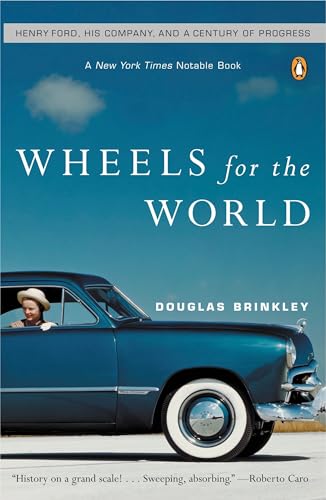
For readers who want the best next step, start with Wheels for the World by Douglas Brinkley. It is the definitive account of how Ford built his empire — and why the wage strategy was inseparable from every other decision the company made.