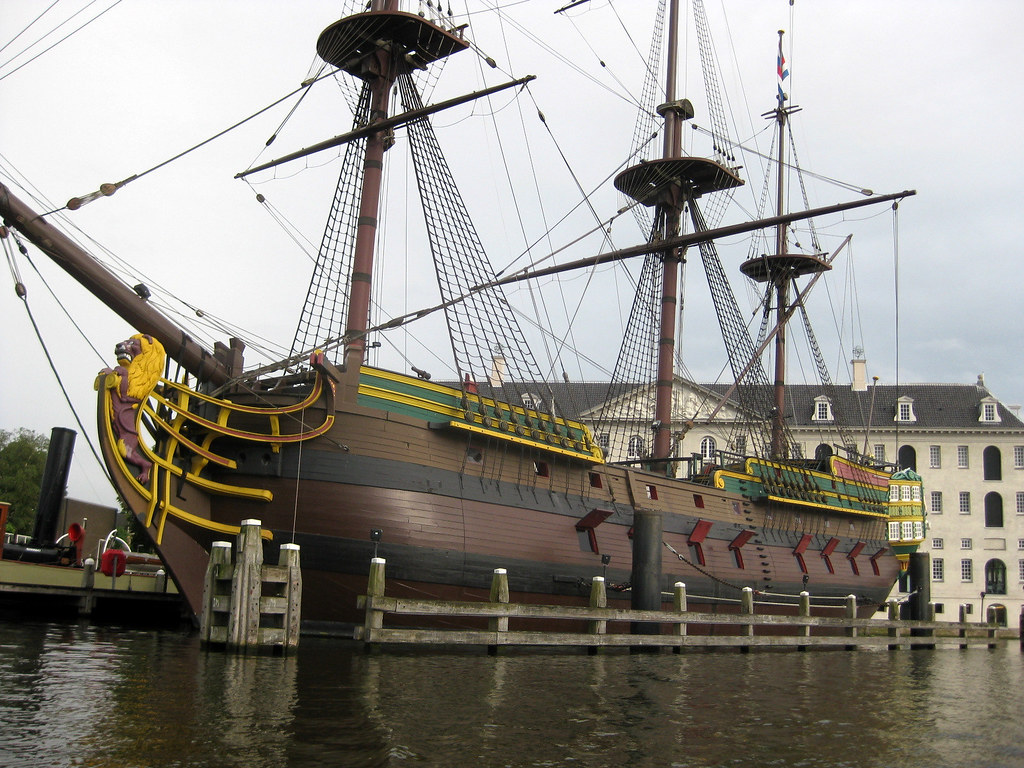
The modern corporation was not born in a glass tower. It was born on the sea, under cannon smoke.
In 1602, the Dutch East India Company entered the world as a business. On paper, that is what it was. In practice, it was something more dangerous: a company with permission to wage commercial war. It could build forts, strike treaties, maintain armed forces, and protect its monopoly by force. That made it one of the most profitable inventions in history.
And one of the most revealing.
The World Before the Fortune
Europe’s hunger for Asian trade created one of the most lucrative commercial theaters in the early modern world. Spices, textiles, luxury goods, and maritime routes promised extraordinary profits. But those profits did not come wrapped in ease. They came with long voyages, military risk, fragmented trading outposts, and intense competition from existing imperial powers, especially Portugal.
The Dutch Republic needed a way to organize that struggle at scale.
Before the VOC, trade ventures were costly, risky, and often fragmented. Capital could be raised voyage by voyage, but the scale required to secure permanent advantage was harder to build. What the Dutch created was a more durable structure: one company, backed by one state, with one monopoly charter and one enormous mission.
Founded in 1602, the VOC was designed to protect Dutch trade in the Indian Ocean and support the Dutch war of independence from Spain. That matters because from the beginning it was not merely commercial. It was geopolitical.
The company received monopoly rights in a vast trading zone between the Cape of Good Hope and the Straits of Magellan. More importantly, it could conclude treaties, build forts, maintain armed forces, and carry out administrative functions overseas.
At that point, the line between company and empire had already started to dissolve.
The Rise
The VOC rose because it solved three problems at once.
First, it solved the capital problem. A joint-stock structure allowed investors to pool risk and support a continuing enterprise rather than a single isolated voyage. That meant the company could think in systems, not expeditions.
Second, it solved the coordination problem. A centralized organization could manage fleets, routes, and overseas operations more effectively than scattered merchants.
Third, it solved the coercion problem by receiving state authority to use force. Where ordinary traders bargained, the VOC could impose.
This was the real breakthrough.

The company’s wealth did not come from clever buying and selling alone. It came from building the conditions under which buying and selling happened on its terms. The VOC was not content to participate in trade. It wanted to shape the map of trade itself.
Under forceful governors-general such as Jan Pieterszoon Coen, the company pushed hard into the East Indies. In 1619 it renamed Jacatra as Batavia, now Jakarta, and used it as a strategic base for regional control. From there, it displaced rivals, secured routes, and deepened its role in the Dutch commercial empire.
That is why the company matters so much in the story of wealth. It showed that the most profitable merchant is often the one who can decide the rules of exchange.
The Expansion of Power
Once the VOC had scale, it began to convert trade power into administrative power.
That shift is critical.
The company prospered through much of the 17th century as the instrument of Dutch commercial dominance in Asia. But as it expanded, it became more than a shipping and trading operation. It increasingly involved itself in governance, territorial management, and agricultural extraction. By the 18th century, it had evolved from a commercial shipping enterprise into something closer to a territorial organization with deep stakes in the produce and politics of the Indonesian archipelago.
This was not a side effect. It was a strategic progression.
If you control routes, then you begin to control ports. If you control ports, then you begin to control terms. If you control terms, then the temptation to control territory becomes overwhelming. The corporation learns that it can govern because governance stabilizes profits.

That is the arc the VOC followed.
At its height, the company represented a stunning combination of private capital and sovereign privilege. Investors enjoyed the upside of monopoly and scale. The Dutch state benefited from trade power and imperial reach. And the company itself became the operating instrument that connected capital markets in Europe to coerced advantage in Asia.
Modern readers can see the pattern clearly. The VOC looked like a business, but functioned like infrastructure plus military leverage plus political franchise. It was multinational not simply because it had offices in many places, but because it integrated finance, logistics, and force across continents.
That integration is what gave it such extraordinary leverage. It did not have to negotiate every market from scratch if it could instead define the environment in which negotiation occurred. This is how an enterprise stops being a participant and starts becoming a gatekeeper.
The Hidden Strategy Behind the Fortune
The hidden strategy behind the VOC was not “global trade.”
That phrase is too gentle.
The real strategy was to turn a company into the governing bottleneck of long-distance commerce.
The VOC raised capital at a scale that let it think beyond one voyage. It received monopoly powers that let it exclude competitors. It used forts, treaties, and armed force to shape the actual environment of exchange. And then it embedded itself so deeply in the system that profit no longer depended only on product margins. Profit depended on control.
That distinction is everything.
Normal merchants compete inside a market. The VOC kept trying to build the market around itself. The spices mattered, but the strategic asset was not cinnamon or cloves alone. It was the route, the port, the legal privilege, the shipping system, and the coercive ability to say who traded and under what terms.

That is why calling it the first multinational is useful but incomplete. It was also one of the first large demonstrations of a deeper truth: the most powerful corporations do not merely scale operations. They seek privileged control over the layer others must pass through.
In modern language, the VOC pursued platform power with cannons.
It also illustrates a darker lesson. Once a company is allowed to fuse investor incentives with state privileges, the upside can be enormous. So can the moral hazard. The same system that makes extraordinary profits can also normalize corruption, abuse, overreach, and debt-fueled decline.
The Cost, Risk, or Collapse
The VOC’s power did not protect it from decay.
Success created its own trap. The company’s far-flung structure became expensive to administer. Corruption spread. Debt mounted. The burdens of governance began to weigh on what had started as a trading enterprise. By the late 17th and 18th centuries, the VOC had lost much of the clarity that made it formidable early on.
It had become bigger, but not necessarily sharper.
This is one of the recurring patterns in the history of empire, whether corporate or political. The system that scales through aggressive control often struggles once administration becomes heavier than strategy. The company that once profited from speed and force gradually became a looser, indebted territorial organization.
Eventually the Dutch government revoked its charter and, in 1799, took over its debts and possessions.
That end matters because it reveals the double edge of corporate empire. Monopoly, military leverage, and administrative power can generate immense returns. They can also generate bureaucratic sprawl, complacency, and political dependency.
Lessons for Modern Business Readers
The VOC’s story is centuries old, but the strategic lessons are still uncomfortably current.
1. The richest firms often control distribution, not just product
The company’s edge came from routes, ports, and monopoly rights. Product mattered, but control mattered more.
2. Political privilege is one of the most powerful business accelerants in history
When a firm gets legal advantages that competitors do not, scale can happen far faster than pure market competition would allow.
3. Capital structure can change the size of the game
The joint-stock model made it possible to think bigger than a single voyage. The financing model shaped the ambition.
4. Force and commerce have often been closer than modern branding suggests
The corporation has a cleaner public image today, but the history is darker. Wealth at scale frequently depends on the ability to shape the operating environment.
5. Great systems can rot from inside
The VOC’s decline is a warning about debt, bureaucratic drift, corruption, and overextension.
6. The most dangerous company is the one that becomes infrastructure
When everyone must pass through your system, your bargaining power changes completely.
That lesson remains as relevant now as it was in the age of sail. The platform may be digital today, but the appetite to become unavoidable has not changed.
There is another reason the VOC belongs at the center of Hidden Fortunes. It reveals that corporations become most powerful when they stop accepting the market as given and start engineering the market around themselves. The Dutch East India Company did not merely discover opportunity in Asia. It constructed advantage through charters, force, and logistics until trade itself began to move through company-designed channels. That is why the story still feels modern and unsettling.
That is the darker business lesson the VOC leaves behind: when scale, distribution, and legal privilege fuse tightly enough, a company can start behaving like a sovereign actor.
It remains one of the clearest prototypes of corporate empire.
Book Recommendation
For readers who want a wider company-and-empire lens, the recommended follow-up is The Anarchy by William Dalrymple. It focuses on the English East India Company rather than the VOC directly, but it is a strong Amazon next read for understanding how chartered companies evolved into engines of empire.