Hook
Some fortunes arrive dressed in velvet and legality. Others arrive through fog, silver, contraband, and the quiet understanding that a market can be profitable precisely because it is morally broken. Jardine Matheson belongs to the second category.
The firm is often remembered as a great trading house of Asia, but that polished description can blur the mechanism that made it powerful. Its rise was tied to the opium trade, to British demand for tea, and to a larger imperial system willing to use force when commerce no longer moved on acceptable terms.
That is what makes this a Hidden Fortunes story. The hidden strategy was not simply selling a product. It was controlling movement inside an imbalanced trade system until private profit and imperial pressure began reinforcing each other.
The World Before the Fortune

Before Jardine Matheson became powerful, Britain faced a stubborn commercial problem in China. British consumers wanted tea in enormous quantities, but China had limited interest in taking Western manufactured goods in return. The result was a draining outflow of silver and a growing obsession with finding a commodity that could reverse the balance.
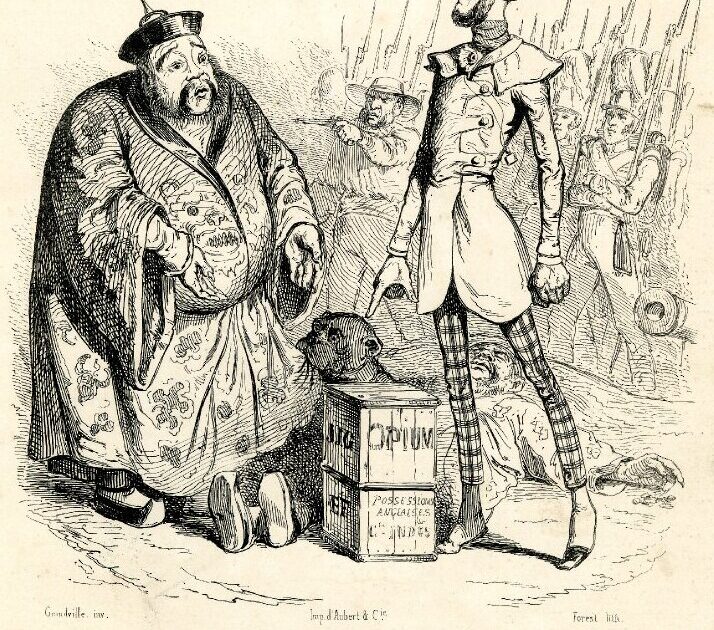
This imbalance created the opening for a brutal solution. Opium, produced in India and smuggled into China despite prohibition, became the commodity that could pull silver back into British commercial circuits. The trade was economically clever and morally ruinous. It created profit by feeding addiction and by exploiting the gap between formal law and practical enforcement.
That was the landscape in which William Jardine and James Matheson operated. They were not inventing the China trade from scratch. They were entering a field where distance, information, shipping discipline, and political confidence could make the difference between a merchant and a power.
The Rise

Jardine Matheson grew by doing more than buying and selling. It built networks. It moved goods quickly, understood the rhythms of ports, cultivated merchant relationships, and treated information as a commercial weapon. In long-distance trade, speed and coordination are forms of wealth because they reduce uncertainty while amplifying margin.
The firm also benefited from a market structure that rewarded operators willing to work close to the edge of law and sovereignty. The opium trade required an appetite for risk, a command of distribution networks, and an understanding that the real value lay not only in the commodity but in controlling the sequence through which that commodity reached buyers and payments returned.
By the 1830s, Jardine Matheson was no longer a peripheral trader. It had become one of the most forceful merchant houses in the China trade, combining entrepreneurship, ruthlessness, and a cold ability to turn unstable routes into repeatable commercial machinery.
That repeatability is what separates opportunism from system-building. A fortune built on one dangerous shipment is fragile. A fortune built on a network that can keep producing margin across many shipments, counterparties, and ports is something else entirely. Jardine Matheson moved toward the second category.
The Expansion of Power
.jpg)
The Qing state’s effort to suppress opium made the firm’s strategy more dangerous and, in some ways, more decisive. When Commissioner Lin Zexu intensified enforcement in 1839, he was not simply interrupting commerce. He was challenging an entire system in which foreign merchants had grown accustomed to treating Chinese law as an obstacle to be worked around.
The resulting escalation fed into the First Opium War, a conflict that should never be reduced to a simple trade dispute. It was a collision between sovereignty and imperial commerce, with private firms embedded in the larger pressure machine. Jardine Matheson did not alone create that war, but it operated inside the business logic that made force appear commercially useful to British interests.
After the war, the reshaped treaty order and the rise of Hong Kong as a British foothold widened the commercial field. Private advantage became entangled with imperial structure. What began as agile trading power became something more stable because the rules of access had been rewritten by gunboats as well as merchants.
The Hidden Strategy Behind the Fortune
.jpg)
The hidden strategy behind the fortune was circulation control in a coercive market. Jardine Matheson made money not only because opium sold, but because the firm mastered the routes, relationships, financing, and political pressures that kept the trade moving despite legal resistance.
This distinction matters because it separates surface scandal from deeper mechanism. A commodity can be profitable for a season. A distribution system backed by superior information, shipping agility, and imperial muscle can be profitable for much longer. The company’s real edge lay in making a dangerous trade operationally reliable enough to scale.
Competitors could join the trade, but not all could match the same network density, intelligence, and timing. A trading house that understands routes, counterparties, and enforcement risk can turn volatility into moat. In nineteenth-century Asia, that moat was strengthened by the British Empire’s willingness to treat commerce as a strategic interest.
The lesson is not to admire the system. It is to see it clearly. Jardine Matheson’s fortune shows that wealth can be scaled through control over movement even when the underlying market is morally indefensible.
The Cost, Risk, or Decline
.jpg)
The moral cost is not a footnote here. Addiction, coercion, imperial violence, and the erosion of Chinese autonomy were built into the structure of the fortune. The wealth was real, but so was the damage that made it possible.
There is also a reputational lesson that outlasts the profit. When a fortune is built through a system later judged as exploitative, its legacy becomes unstable. Institutions may survive, diversify, and modernize, but the origin story remains charged because the original mechanism cannot be morally cleaned by later polish alone.
That darker edge should not be treated as a footnote. It is part of the real anatomy of power. Many wealth systems become most impressive at the exact moment they are also becoming morally brittle, politically exposed, or structurally overconfident.
Lessons for Modern Business Readers

1. Routes are often more valuable than goods
The operator who controls circulation can extract more durable value than the operator who focuses only on inventory.
2. Trade imbalances invite aggressive solutions
When one side of a market cannot find a profitable exchange, someone will search for a corrective product or mechanism, often with dark consequences.
3. Political protection can amplify commercial scale
A business becomes far more dangerous when state power starts defending its operating model.
4. Distance can hide moral cost
Many wealth systems stay respectable because the damage is separated from the boardroom by geography and language.
5. Logistics can become an ethical test
Operational brilliance is not morally neutral when it is serving a predatory system.
6. Legacy matters as much as cash flow
A fortune can compound financially while remaining historically compromised in the public memory.
For modern readers, the relevant business lesson is not imitation. It is recognition. Whenever a company becomes unusually skilled at moving goods, money, or information through a morally gray system, the strategic temptation to treat efficiency as innocence becomes very strong.
Hidden Fortunes is strongest when it refuses that temptation. Jardine Matheson belongs in the canon not because the wealth was clean, but because the mechanism was powerful, scalable, and revealing.
Book Recommendation
For readers who want the best next step, start with Imperial Twilight by Stephen R. Platt. It is the right Amazon follow-up for this topic because it frames the wider imperial crisis around the China trade and shows how commerce, violence, and diplomacy fused in the making of British power.